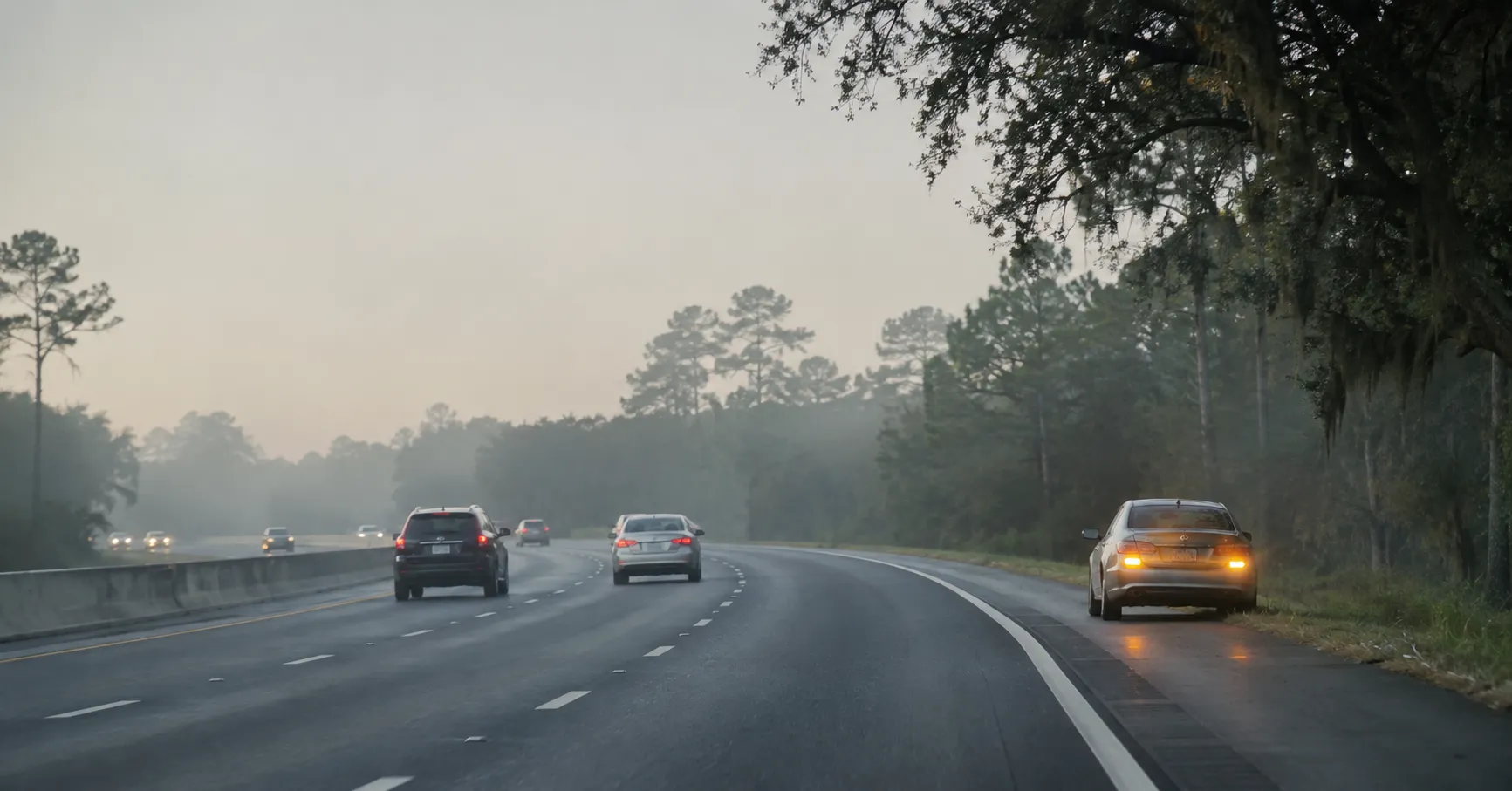
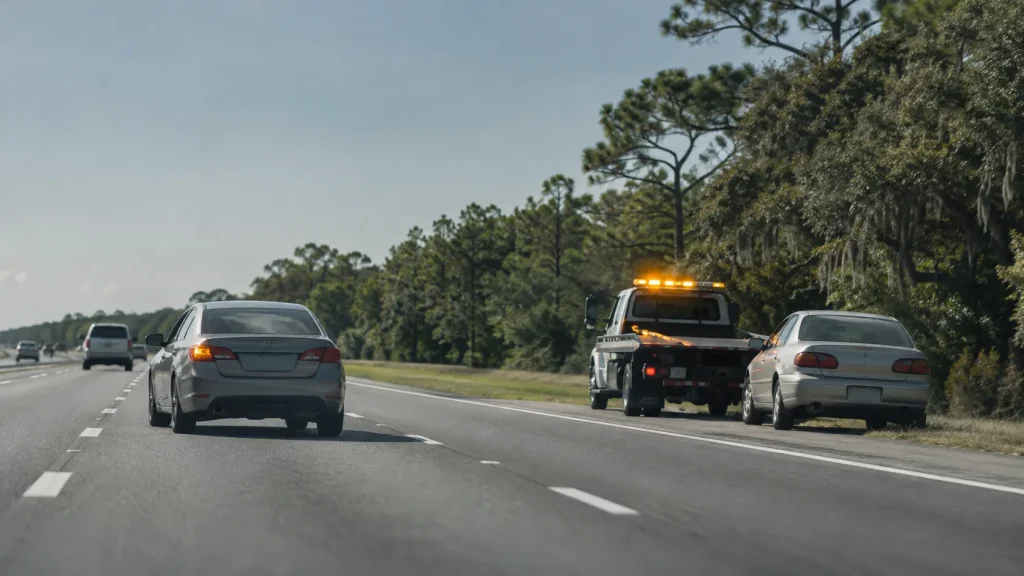
The Suncoast Parkway is a fast, limited-access toll road through Hernando County, and most crashes on it come down to speed, following too closely, and merging. Florida’s Move Over law also requires you to move over or slow down for stopped emergency vehicles, tow trucks, and disabled cars with their hazard lights on. With holiday travel starting, here’s how Spring Hill drivers can stay safe on the Parkway and what to do if something goes wrong.
Why the Parkway is different from local roads
The Parkway runs along the east side of Spring Hill, with interchanges at County Line Road, Spring Hill Drive, and SR 50 (Cortez Boulevard). Compared with U.S. 19 or Mariner Boulevard, it has:
- Higher speeds, so a small mistake can become a serious motor vehicle accident
- Long gaps between exits, so a breakdown can leave you stranded on the shoulder
- Merging traffic at each interchange, where drivers enter at speed
- Early-morning fog in the cooler months, which can cut visibility fast on wooded stretches
Florida's Move Over law, explained
Under Fla. Stat. § 316.126, you must move over or slow down for vehicles stopped on the roadside, including:
- Law enforcement and other emergency vehicles
- Tow trucks, sanitation, utility, and road maintenance vehicles with warning lights on
- Any disabled vehicle showing hazard lights or flares, or with people visibly present
On a road with two or more lanes in your direction, like the Parkway, move out of the lane closest to the stopped vehicle when it’s safe. If you can’t move over safely, slow down. On a two-lane road, slow to 20 mph below the posted limit when the limit is 25 mph or more.
If your car breaks down on the Parkway
- Turn on your hazard lights right away.
- Pull as far right onto the shoulder as you can.
- Get away from traffic if you can do it safely. If not, stay in the car with your seat belt on.
- Call for help and give your direction of travel and the nearest interchange.
Four habits for safer Parkway driving
- Leave extra following distance. At highway speed, you need far more room to stop, and tailgating is how many rear-end collisions happen.
- Merge at speed and signal early at County Line Road, Spring Hill Drive, and SR 50.
- Slow down in fog and use low-beam headlights.
- Watch for slowing traffic near interchanges, especially during holiday travel weekends.
What to do after a crash on the Parkway
- Check for injuries and call 911 so law enforcement can document the crash. Give the nearest interchange and direction.
- Move out of the travel lanes if no one is hurt and the car can be driven. Florida law requires drivers to make every reasonable effort to move a damaged vehicle that’s blocking traffic (Fla. Stat. § 316.061).
- Photograph the vehicles, the scene, and road conditions once you’re safe.
- Get the other driver’s information and any witness names.
- Get medical care. Read why in our post on seeing a doctor even if you feel fine.
Frequently asked questions
Does the Move Over law apply to a regular car broken down on the shoulder? Yes. Florida’s law covers a disabled vehicle showing hazard lights or flares, or with people visibly present, not just police and tow trucks.
What if I can’t safely change lanes? The law says to move over only when it’s safe. If you can’t, slow down.
How long do I have to file a claim after a crash? For most negligence claims arising on or after March 24, 2023, Florida’s deadline is two years (Fla. Stat. § 95.11).
Talk to a Spring Hill car accident attorney
A Florida car accident at highway speed can change your life in a second. If you were injured in a Hernando County crash, you don’t have to handle the insurance company or your car accident case alone. The attorney you meet at LMD is the attorney who handles your case, and we prepare every case as if it’s going to trial. Learn more about our Spring Hill car accident lawyers, or contact us.
Call (352) 686-0080 for a free case evaluation at our office at 2190 Commercial Way, Spring Hill, FL 34606. No fee unless we win.
This article is general information, not legal advice. Reading it does not create an attorney-client relationship.


 (727) 849-5353