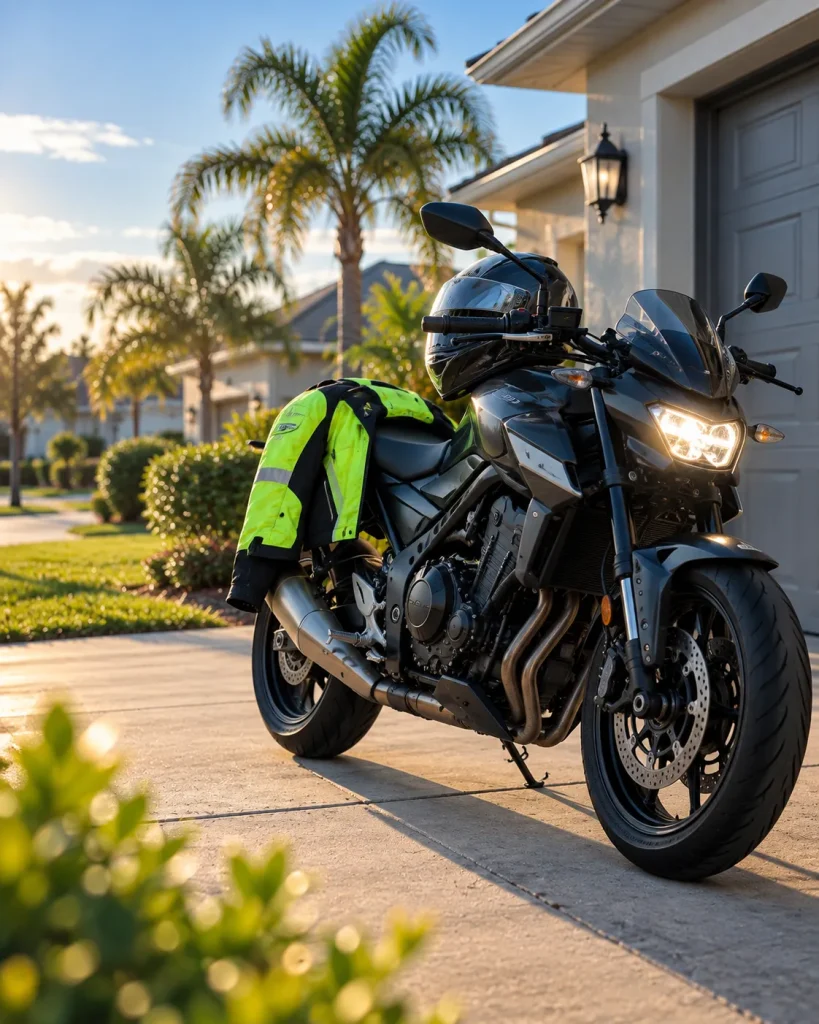
Cooler fall and winter weather brings more motorcycles onto Spring Hill roads, and the most common danger is a car turning left across a rider’s path. Riders can lower that risk with visibility and positioning, and drivers can lower it by looking twice. If a crash happens anyway, Florida’s rules on insurance and fault matter right away.
Why left turns are the big risk
A motorcycle’s narrow profile makes it easy for a driver to misjudge its speed and distance, or to miss it entirely. The classic crash happens at an intersection or driveway when a driver turns left across the rider’s lane.
Florida law puts the duty on the turning driver. Under Fla. Stat. § 316.122, a driver turning left must yield to oncoming vehicles that are in the intersection or close enough to be an immediate hazard. That includes motorcycles.
Five ways riders can stay visible on Spring Hill roads
1. Ride where drivers can see you
Use your lane position so you’re visible in a waiting driver’s line of sight, not tucked behind a truck. On Cortez Boulevard, U.S. 19, and Mariner Boulevard, assume a driver at a left-turn lane hasn’t seen you until they clearly stop.
2. Cover your brakes at intersections and driveways
Shopping plazas along Commercial Way and Spring Hill Drive mean cars pull out often. Ease off the throttle and cover your brakes so you can react fast.
3. Wear bright gear and keep your headlight on
High-visibility jackets and a working headlight make you easier to pick out against traffic and shadows, especially now that sunset comes earlier.
4. Know Florida's helmet rule
Florida requires helmets for riders under 21. A rider over 21 may ride without a helmet only if they’re covered by an insurance policy with at least $10,000 in medical benefits for motorcycle crash injuries (Fla. Stat. § 316.211). Either way, a helmet is your best protection.
5. Check your own medical coverage
Many riders don’t realize Florida’s no-fault PIP coverage doesn’t follow them onto a motorcycle. PIP law defines a “motor vehicle” as one with four or more wheels (Fla. Stat. § 627.732). Talk to your insurance agent about medical payments and uninsured motorist coverage on your bike.
What to do after a motorcycle crash
- Get medical care first. Riders often have injuries that aren’t obvious at the scene.
- Call 911 and get a crash report. Ask the deputy or officer how to get a copy.
- Leave your gear as it is. Your helmet, jacket, and bike can show how the crash happened. Don’t repair or throw them out.
- Photograph the scene. Capture the intersection, the other car’s position, skid marks, and any blocked sightlines.
- Get witness names and numbers. Other drivers and nearby workers can confirm who turned in front of whom.
- Talk to a lawyer before the insurer. Riders sometimes face bias from adjusters who assume the motorcycle was at fault.
Frequently asked questions
Does PIP cover me if I’m hurt on my motorcycle? Generally no. Florida’s PIP law covers vehicles with four or more wheels, so riders need their own medical and uninsured motorist coverage. A claim against an at-fault driver is still possible.
Who is at fault when a car turns left in front of a motorcycle? The turning driver has a legal duty to yield under Fla. Stat. § 316.122. Fault still depends on the facts, like speed and visibility. Under Florida’s comparative negligence rule, a rider found more than 50% at fault can’t recover damages (Fla. Stat. § 768.81).
If I wasn’t wearing a helmet, can I still bring a claim? Often, yes. Not wearing a helmet doesn’t excuse a driver who caused the crash. The insurer may argue it affected your injuries, so get advice on your situation.
Talk to a Spring Hill motorcycle accident attorney
After a crash, you need someone in your corner who takes riders seriously. LMD prepares every case as if it’s going to trial, and the attorney you meet is the attorney who fights for you. Learn more about our Spring Hill motorcycle accident lawyers, or contact us.
Call (352) 686-0080 for a free case evaluation at our office at 2190 Commercial Way, Spring Hill, FL 34606. No fee unless we win.
This article is general information, not legal advice. Reading it does not create an attorney-client relationship.


 (727) 849-5353