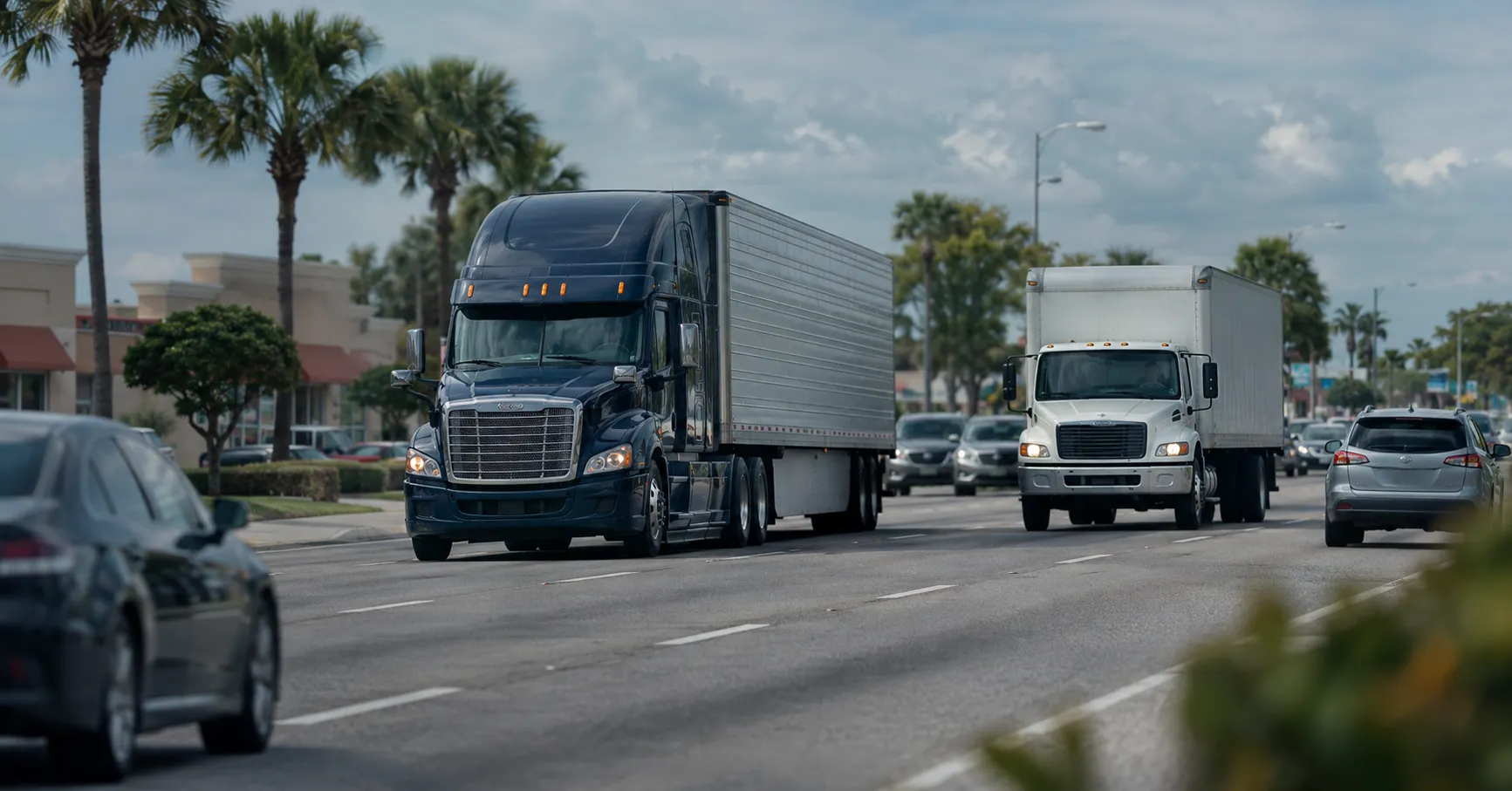
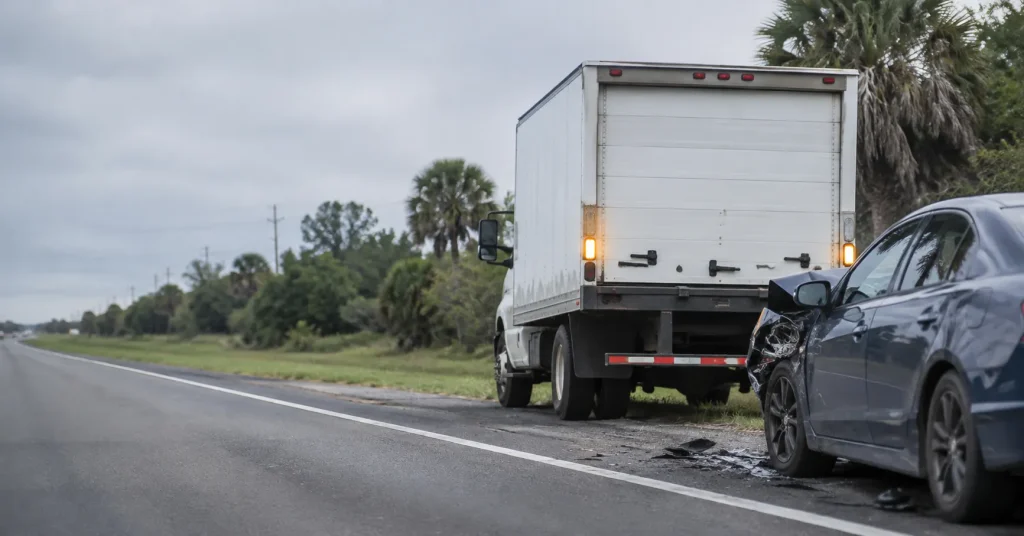
When a truck causes a crash, the driver may not be the only one responsible. The trucking company, a delivery contractor, or the business that loaded or maintained the truck may share the blame, and federal safety rules apply. With holiday shipping season putting more big rigs and delivery trucks on U.S. 19, here’s what New Port Richey drivers should know.
Why truck crash claims are different
Federal safety rules apply in Florida
Florida adopts the federal motor carrier safety regulations. Under Fla. Stat. § 316.302, owners and drivers of commercial motor vehicles are subject to 49 C.F.R. parts 382–386 and 390–397. Those rules cover driver qualifications, vehicle inspection and maintenance, and hours-of-service limits on how long a driver may be behind the wheel.
More than one party may be responsible
In a typical car crash, the claim is against one driver. In a truck crash, responsibility may also reach:
- The trucking or delivery company, for the driver’s actions on the job or for pushing unsafe schedules
- The company that loaded the cargo, if an overloaded or shifting load played a part
- The business that maintained the truck, if worn brakes or tires contributed
Each one typically has its own insurer, and each will try to point at the others.
The key evidence belongs to the trucking company
Electronic driving logs, inspection reports, and maintenance records are in the carrier’s hands. Some of it may not be kept forever. An attorney can send a letter asking the company to preserve that evidence before it’s lost.
Sharing U.S. 19 and SR 54 with trucks
- Stay out of the blind spots. If you can’t see the truck driver’s mirrors, the driver probably can’t see you. The right side is the biggest blind spot.
- Pass on the left and don’t linger. Move past at a steady speed, then leave plenty of room before pulling back in. A loaded truck needs far more distance to stop than a car.
- Give wide right turns room. Trucks often swing left before turning right into plazas along U.S. 19 and Little Road. Don’t squeeze into the gap.
- Watch for double-parked delivery trucks. During the holidays, delivery trucks stop in neighborhoods and plaza lanes. Slow down and watch for people stepping out from behind them.
What to do after a truck crash
- Call 911 and get medical care. The size of a truck means injuries are often more serious than they first seem.
- Photograph the truck. Capture the company name, the USDOT number on the cab door, the license plate, and the damage.
- Get the driver’s and company’s information. Ask for the driver’s name, employer, and insurance.
- Be careful with the insurer. The trucking company’s insurer may call quickly. Read our post on recorded statements before you agree to one.
- Call an attorney fast. The sooner a preservation letter goes out, the better the chance of keeping logs and records.
Frequently asked questions
Do federal trucking rules apply to crashes in Florida? Yes. Fla. Stat. § 316.302 makes commercial vehicle owners and drivers in Florida subject to the federal motor carrier safety regulations, including hours-of-service limits.
Who pays if a delivery driver hits me? It depends on who the driver works for and how they’re classified. The delivery company, a contractor, or the driver’s own insurer may be involved. An attorney can identify every policy that may apply.
How long do I have to file a claim? For most negligence claims arising on or after March 24, 2023, Florida’s deadline is two years (Fla. Stat. § 95.11). Truck evidence can disappear long before that, so don’t wait.
Talk to a New Port Richey truck accident attorney
Trucking companies and their insurers move fast after a crash. LMD prepares every case as if it’s going to trial, and the attorney you meet is the attorney who fights for you. Learn more about our New Port Richey truck accident lawyers, or contact us.
Call (727) 849-5353 for a free case evaluation at our office at 9020 Rancho Del Rio Drive, Suite 101, New Port Richey, FL 34655. No fee unless we win.
This article is general information, not legal advice. Reading it does not create an attorney-client relationship.


 (727) 849-5353