

 (727) 849-5353
Personal Injury Claim Process West Central Florida

Personal Injury Claim Process Explained for Accident Victims in West Central Florida
An accident can change everything in seconds. One moment you are driving home on US-19 or shopping at a local plaza, and the next you are dealing with pain, medical bills, and an insurance company that seems more interested in protecting its bottom line than helping you recover. If you were hurt anywhere in West Central Florida, from Pasco and Pinellas counties up through Hernando and Citrus, understanding how the personal injury claim process works puts you back in control. Whether you need a personal injury lawyer West Central Florida residents trust or simply want to know your rights, this guide walks you through it.
At LMD Injury Lawyers, we walk accident victims through this process every day. Here is what it actually looks like, step by step.
Step 1: Get Medical Care Right Away
Your health comes first, and so does your claim. Florida’s no-fault insurance system requires you to seek treatment within 14 days of a car accident to access your Personal Injury Protection (PIP) benefits. Wait longer than that and you may forfeit up to $10,000 in coverage you already paid for.
Even if you feel fine, get checked out. Soft tissue injuries, concussions, and internal injuries often take days to show symptoms. Adrenaline after a crash can mask pain that surfaces the following morning, and some traumatic brain injuries produce symptoms only after swelling begins. A documented medical record created immediately after your accident is also the single strongest piece of evidence connecting your injuries to the crash.
PIP benefits Florida drivers carry cover 80% of reasonable medical expenses and 60% of lost wages up to those policy limits — but only for injuries deemed an “emergency medical condition” by your treating provider. If your diagnosis falls short of that threshold, your benefits may be capped at $2,500. That distinction matters, so be candid with your doctor about every symptom you are experiencing, no matter how minor it seems in the moment.
Follow every treatment plan your doctor recommends and keep all your follow-up appointments. Insurance adjusters routinely argue that gaps in treatment mean the victim was not seriously hurt, and they use those gaps to justify lower settlement offers. Consistent care not only supports your recovery — it protects the value of your claim.
Step 2: Document Everything
The best claims are built on evidence gathered early. If you are physically able, or if a family member can help, collect:
- Photos of the accident scene, vehicle damage, and visible injuries
- Contact information for every witness
- The police report or incident report number
- Records of every medical visit, prescription, and out-of-pocket expense
- A simple daily journal describing your pain levels and how the injury affects work and family life
West Central Florida’s mix of heavy commuter corridors, seasonal traffic, and tourist activity means fault is often disputed. Strong documentation shuts down those disputes before they start.

Step 3: Talk to a Personal Injury Lawyer Before Talking to Insurance
The at-fault party’s insurance adjuster may call you within days sounding friendly and helpful. Remember that their job is to close your claim for as little money as possible. Anything you say in a recorded statement can be used to devalue your case.
Common tactics include asking open-ended questions designed to get you to downplay your pain, emphasizing how quickly they can get you a check, and presenting a lowball offer before you have any idea what your full medical costs will be. Once you accept a settlement, you typically cannot go back for more — even if your injuries turn out to be far more serious than they first appeared.
This is the point where most accident victims benefit from legal representation. A personal injury lawyer handles all communication with insurers, investigates fault, and calculates the true value of your claim — including future medical needs, long-term rehabilitation costs, and lost earning capacity that adjusters conveniently leave out. An experienced attorney also knows how to identify all available insurance coverage, including underinsured motorist (UM/UIM) policies that many victims never think to pursue.
Most personal injury attorneys — including every Florida personal injury attorney at LMD Injury Lawyers — work on a contingency fee basis. That means you pay nothing out of pocket to hire representation. The attorney’s fee comes as a percentage of your final recovery, so your lawyer is financially motivated to maximize your outcome — not just close the file.
Step 4: Investigation and Demand
Once your medical treatment stabilizes and your doctors can project your long-term prognosis, your legal team assembles the full picture: liability evidence, medical records, expense documentation, and expert opinions where needed. That package becomes a demand letter sent to the insurance company outlining what happened, why their insured is responsible, and what fair compensation looks like.
The demand letter is more than a formality — it sets the tone for every negotiation that follows. A well-constructed demand includes a detailed account of the accident, a summary of your injuries and treatment, documentation of every economic loss (medical bills, lost wages, out-of-pocket expenses), and a clear argument for non-economic damages such as pain and suffering, emotional distress, and loss of enjoyment of life.
Timing matters here too. Your legal team will typically wait until you reach maximum medical improvement (MMI) — the point at which your doctor determines your condition has stabilized — before sending the demand. Settling too early, before your full prognosis is known, is one of the most common and costly mistakes accident victims make on their own. Once a settlement is signed, there is no going back to collect more, even if additional surgeries or complications emerge later.
Step 5: Negotiation, and Litigation if Necessary
Most personal injury claims in Florida settle through negotiation. Insurers know which law firms prepare cases thoroughly and which ones fold. When an insurer refuses to offer fair value, filing a lawsuit moves the claim into litigation, where the discovery process often surfaces evidence that changes their math.
Litigation does not necessarily mean going to trial. The vast majority of lawsuits settle before a jury ever hears the case. What litigation does is change the insurer’s calculus — they are now facing legal fees, depositions, document requests, and the real possibility of a jury award that far exceeds the settlement they declined. That shift in leverage is often exactly what it takes to reach a fair resolution.
The discovery phase can also uncover critical evidence: surveillance footage, cell phone records, internal company communications in commercial vehicle cases, and prior complaints against a negligent driver or property owner. Your attorney may retain accident reconstruction experts, medical specialists, or economists to project lifetime earnings losses — all of which strengthen your position at the negotiating table.
Keep in mind that Florida law now gives most accident victims only two years from the date of injury to file a lawsuit — and for a car accident claim Florida courts strictly enforce that deadline. That deadline arrives faster than you expect, especially when you are focused on recovery. Missing it generally means losing your right to pursue compensation entirely, regardless of how strong your case might have been. Starting the process early gives your legal team the time needed to build the strongest possible claim.
Why Local Knowledge Matters Across West Central Florida
A claim in this region is not handled in a vacuum. Where your case would be filed matters, whether that is the Pinellas County Justice Center, the West Pasco Judicial Center, or the courthouses serving Hernando and Citrus counties. Jury tendencies, local court procedures, and even the reputation of the law firm bringing the claim all influence how insurers value your case.
The roads themselves tell part of the story. US-19 through Pasco and Pinellas counties is one of the most dangerous highways in Florida — a mix of heavy commercial traffic, aging infrastructure, and high pedestrian activity. SR-52, US-41, and the corridors through the Spring Hill area see regular serious crashes. Understanding the accident patterns, local emergency response agencies, and which medical providers document injuries effectively in each county is knowledge that comes only from working these cases day in and day out.
Florida’s comparative negligence law also means that the insurer will look for any opportunity to assign partial fault to you as the victim, which directly reduces your recovery. An attorney familiar with local juries and local defense tactics knows how to build a case that holds up under that scrutiny.
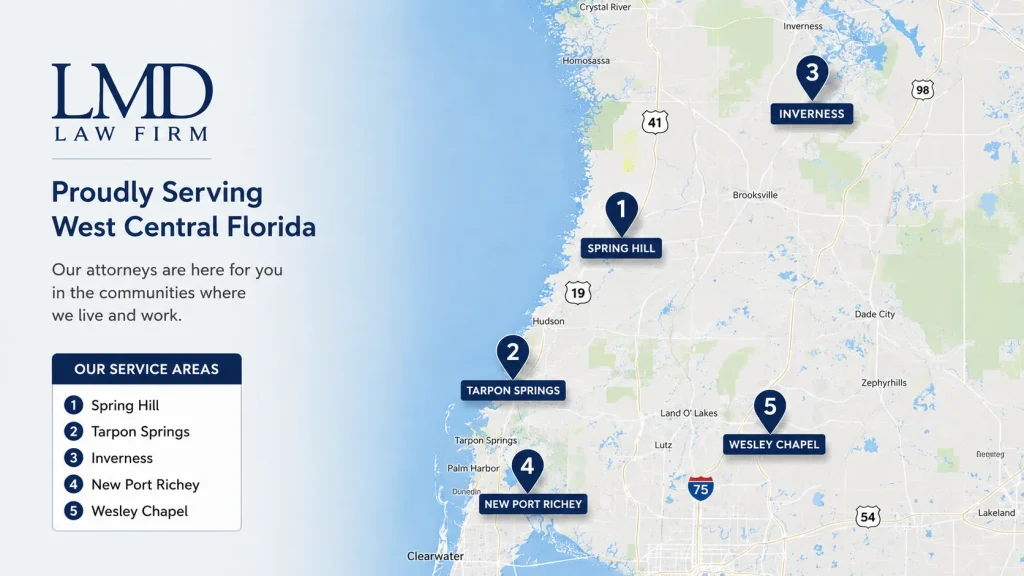
LMD Injury Lawyers serves accident victims throughout West Central Florida, including Spring Hill, Tarpon Springs, Inverness, New Port Richey, and Wesley Chapel. We know these roads, these courts, and the insurance tactics common in this market.
Talk to Us Before You Talk to the Insurance Company
The claim process rewards preparation and punishes delay. If you or a loved one was injured in an accident anywhere in West Central Florida, contact LMD Injury Lawyers for a free consultation. You pay nothing unless we win your case.